The Coastal States Organization represents the nation’s Coastal States, Territories, and Commonwealths on ocean, coastal, and Great Lakes resource issues. Having trouble opening links? View this on our website: https://coastalstates.org/resources/ |
|
New Study: Thousands of Toxic Sites at Risk of Flooding in Future Due to Sea Level Rise |
|
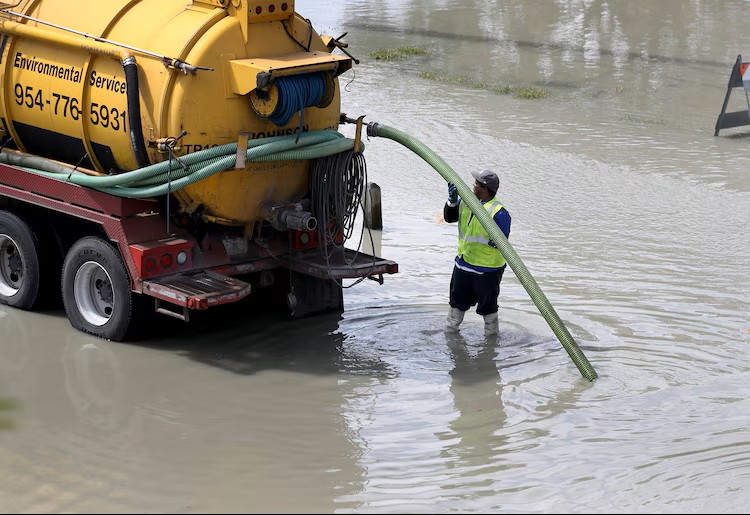
Source: Joe Raedle/Getty Images |
|
| A new study published by Nature found that under a high greenhouse gas emissions scenario, more than 5,500 hazardous sites across the U.S. will be at risk of a 1-in-100-year flood by the year 2100. These sites include facilities that handle sewage, toxic waste, oil and gas and other industrial pollutants as well as formerly used defense sites. Of the the at-risk sites, at least 3,800 locations are projected to flood by 2050, the study found. In the past several decades, extreme flooding events caused by storms like Hurricane Katrina in 2005 and Hurricane Harvey in 2017 flooded industrial facilities, releasing toxic chemicals into the floodwaters and air. Researchers at UCLA put together a database of industrial and contaminated sites, such as sewage treatment plants, active oil and gas refineries and other types of industrial facilities — a total of nearly 50,000 sites across 23 coastal U.S. states and Puerto Rico. They then estimated flood risks at those locations for the years 2050 and 2100 under greenhouse emissions scenarios: high emissions and moderate emissions. The findings indicate that the states at most risk of flooding at toxic sites include Florida, New Jersey, California, Louisiana, New York, Massachusetts and Texas. Those seven states account for nearly 80% of the hazardous sites at risk by 2100, according to the paper. The researchers also found that residents in marginalized communities will likely be impacted by flooding at toxic sites at higher rates. They found that low-income communities, communities of color and communities with low levels of voter turnout and access to vehicles are more likely to live near sites of future flood risk due to sea level rise. Read more here. |
|
| In the States and Territories |
|
| Maine Office of Community Affairs Announces Grants for Resilience and Hazard Mitigation Projects in Coastal Communities The Maine Office of Community Affairs’ Maine Coastal Program (MCP) and Municipal Planning Assistance Program (MPAP) announced on Wednesday, November 12th approximately $550,000 to support local or regional planning projects that prepare coastal communities and critical public infrastructure for future hazards and storms and to advance community resilience planning. The funding is available through two grants, the Shore and Harbor Planning Grant and the Coastal Community Grant, both supported by funding from the National Oceanic and Atmospheric Administration’s (NOAA) annual grant to Maine Coastal Program. Awards of up to $50,000 for individual applicants and $75,000 for group applicants will support priorities such as long-term coastal hazard and risk assessments, designing resilient infrastructure, improving public access to the coast, and improving land use planning and local ordinances to address future hazards. Read more here. Maryland – Bohemia River Living Shoreline Project Protects Parkland in Cecil County On the edge of Great Bohemia Creek, where in past years rushing water, boat wakes, and storm runoff undercut the riverbanks, a variety of natural shoreline protections now buffer the land at Bohemia River State Park. Marshes planted with grasses are reinforced with log structures and vegetated rock sills. Further inland, live stakes and tree plantings add another layer of shoreline fortification. “The living shoreline at Bohemia River State Park stabilizes the shoreline, mitigates active erosion, enhances aquatic habitat, and improves water quality,” Park Manager Chris Grieco said. “This high-traffic location in a popular public park allows it to serve as a demonstration project with educational and outreach opportunities showcasing the benefits of shoreline restoration and riparian buffer preservation.” The Bohemia River State Park project was supported by two grants from DNR’s Chesapeake and Atlantic Coastal Bays Trust Fund—$65,000 for the design and $886,000 for the implementation of the project. Read more here. |
| Alabama – $24 Million to Fund Creation of Wetlands in Upper Mobile Bay The Alabama Port Authority said Wednesday, November 19th that a plan to create hundreds of acres of wetlands in a portion of upper Mobile Bay has taken two big steps forward. The Upper Mobile Bay Wetlands project has been in the works for years, with backers saying it will provide a “beneficial use” for dredge spoil by creating up to 1,200 acres of wetlands that would serve as habitat and a buffer against erosion. The first new development is that the Gulf Coast Ecosystem Restoration Council has released a draft 2026 list of projects due to receive money from the Deepwater Horizon oil spill disaster, under a process defined by the federal RESTORE Act. The draft Funded Priorities List includes a $24 million allocation for the wetlands project. According to a summary released by the Alabama Department of Conservation and Natural Resources (ADCNR), the $24 million will allow the state to construct “a 100-acre wetland restoration cell in Upper Mobile Bay as the first phase of work that will result in 1,200 acres of tidal wetlands.” The 100-acre site will feature “a semi-submerged containment area and placement of dredge material.” Read more here. Texas – Coastal Surge Project Advances Toward 2036 Completion Community members and leaders alike on November 20th met in Port Arthur to discuss the progress and future of a multi-million-dollar coastal protection project aimed at reducing storm surge risk from Orange to Galveston Bay. The project began with a feasibility study in 2017, funding from Congress in 2018, the first contract award in 2019, and the beginning of construction in 2020. Officials announced they expect completion in 2036. The original levee system was authorized in 1962 and built between 1966 and 1983 to withstand a 14-foot surge. Today it includes nearly 28 miles of earthen levee, more than six miles of floodwalls, 34 drainage structures, 26 closure gates, and 13 pump stations. The Corps is now evaluating the system to determine what needs to be repaired or replaced. New modeling tools are being used to study severe storm scenarios and plan upgrades intended to keep the system effective for the next 50 years. Read more here. |
| Michigan – EGLE Announces Eight Grants to Protect or Improve Water Quality The Michigan Department of Environment, Great Lakes, and Energy (EGLE) announced about $2.9 million in Nonpoint Source (NPS) Program grants. These funds will support eight projects that will prevent, reduce, or eliminate polluted runoff and other nonpoint sources of pollution – caused when rain, snowmelt, or wind carry pollutants from land into lakes, streams, or wetlands. The purpose of these grants is to carry out locally developed watershed management priorities that EGLE has approved to help restore impaired waters and protect high-quality waters by reducing NPS sediments, nutrients, bacteria, and other contaminants. Projects include implementing livestock best management practices and addressing high levels of bacteria from human sources. Read more here. Research Shows Plastic Pollution in Lake Erie Soared Over the Past Decade In 2014, Sherri Mason ventured out onto Lake Erie aboard the U.S. EPA’s Lake Guardian research vessel and came back with remarkable evidence of plastic floating in the water. She made a return trip in July 2024 – hitting several of the same spots she did in 2014 – and found the number of tiny plastic bits on the surface had increased dramatically. All five sites showed increases, she said, suggesting to her that the volume of plastic in the lake had indeed gone up. The area nearest to Cleveland roughly doubled to 98,000 particles per square kilometer. Closer to Buffalo, the increases were even more dramatic. Mason retrieved more than 700,000 particles per square kilometer off the Pennsylvania coast, compared with 19,000 in 2014. And in waters off Long Point, Canada, the numbers exceeded 500,000, up from 9,500. Read more here. |
| California – Conservancy Board Awards over $15 Million for Coastal Restoration, Public Access, and Wildfire Resilience The Board of the State Coastal Conservancy awarded a total of over $15 million to projects that will help to restore the California coast, improve public access to it, and increase its resilience to climate change. The majority of funding is going to ten projects that aim to reduce the risk and impact of catastrophic wildfires along the coast. Other projects involve community engagement, studying sea level rise, and watershed restoration projects. Recipients include tribal authorities, non-profits, and local governments. Read more here. Guam – New Coastal Sign at Paseo de Susana Highlights Atulai A new coastal sign at Paseo De Susana Park in Hagåtña highlights the bigeye scad mackerel, known locally in Chamoru as atulai and is a fish that is frequently caught in the area. It’s the 11th coastal sign the Bureau of Statistics and Plans has installed throughout the island. Atulai fishing is especially popular in the Agana Boat Basin during “tiempon atulai” or “atulai season,” which typically peaks in November and lasts from fall through early spring, BSP said in a release. Beyond marine life education, the sign provides essential information on hazardous marine species, water safety guidelines, marine preserve boundaries, responsible boating practices, tips for protecting Guam’s coastal and marine ecosystems, and surfing advisories for experienced surfers in the area. Together, these signs help promote coastal education and support Guam’s ecotourism efforts, BSP said. Read more here. |
| [NEW] Great Lakes Climate Adaptation Resource Guide For hundreds of small and medium-sized communities across the Great Lakes region, preparing for the water-related impacts of changing weather patterns can be challenging. The International Joint Commission’s (IJC) Great Lakes Water Quality Board has developed a new Great Lakes Climate Adaptation Resource Guide. The guide highlights tools and approaches (including the CALM community of practice!) to help communities integrate Great Lakes water topics into their climate adaptation and resilience strategies. For additional information, read the one-pager or view the informational webinar. Read the full guide here. [NEW] Coastal Southeast Technical Assistance Application For those that haven’t heard, the Coastal Stormwater Center of the Southeast (CSC) is one of four EPA-funded Stormwater Centers of Excellence across the U.S. The Center for Watershed Protection is honored to lead the CSC alongside an incredible team of partners: University of Florida, East Carolina University, North Carolina Coastal Federation, Clemson University, Virginia Tech, University of Georgia, and Auburn University. Through the CSC, we’ll be offering technical assistance at no cost, to state, Tribal, and local governments and environmental non-profits tackling stormwater challenges across coastal VA, NC, SC, GA, FL, and AL. This is just one of the many initiatives we’ll be rolling out to support resilience and innovation across the region. Learn more here. Funding Opportunity: Great Lakes Restoration Community Grant Program The Great Lakes Restoration Community Grant Program (GLRCGP) application is now open! The program’s primary goal is to fund restoration projects in Great Lakes communities with environmental concerns in support of GLRI objectives and offer technical assistance and minimize administrative challenges associated with applying for and managing federal grant funds. Cities, states, Tribes and nonprofit organizations representing Great Lakes communities can apply directly to the Great Lakes Restoration Community Grant Program. The submission deadline for Letters of Intent is January 16, 2026. Learn more here. Partnership Efforts and New Resources to Support BUDM Through its Coastal Zone Initiative to increase coastal habitat restoration and Beneficial Use of Dredged Material (BUDM) for habitat restoration and resource protection in the US, Manomet Conservation Sciences has worked with the Coastal States Organization and numerous partners to advance BUDM project planning in partnership with the U.S. Army Corps of Engineers in Southeast states, develop case studies on coastal restoration projects, and deliver a series of technical webinars. Deliverables, recordings, and more information are available on the Coastal Zone Initiative webpage. Coastal Accelerator Cohort Application Now Open The goal of this program is to build coastal climate resilience and meet coastal 30×30 goals in the Pacific region of the United States. Coastal Quest is looking to fund mid-stage nature-based solutions, such as coastal restoration or protection projects, that have already begun scoping, planning, and feasibility analysis–and to assist in moving those projects through planning to implementation as members of a Coastal Accelerator Cohort. In addition to funding, Coastal Quest is offering technical support to Coastal Accelerator Cohort members. This could include fundraising and long-term financing, project planning and permitting, building community support, developing key partnerships, refining communications tools, and other support as needed. If you are a community-based or non-profit organization, Tribe, tribal or indigenous group, or public agency working on multi-benefit coastal projects in the Pacific Region, this opportunity may be for you! The deadline to apply is Friday, November 21, 2025. Learn more here. Serious Games for Coastal and Marine Conservation, Management, and Adaptation So-called “serious games” are designed for purposes beyond just entertainment, and they can be a powerful tool for teaching, engaging stakeholders, conducting research, and evaluating public policy. OCTO’s The Skimmer newsletter has compiled information about role-playing/simulation games that allow players to experiment with coastal and marine conservation, management, and adaptation actions (or inaction) to improve understanding of how coastal and marine ecosystems – particularly resource users and human communities – work. This compilation of games is continually updated. If you have additional games for us to consider, please send relevant information to sarah@octogroup.org. We are specifically looking for games with a management or conservation component (i.e., not solely focused on species identification or ecology.) Thank you for your assistance! Funding Opportunity: $1.45 Billion in Supplemental Economic Funding Available for Disaster Recovery The United States Economic Development Administration has announced the Notice of Funding Opportunity (NOFO) for its Fiscal Year (FY) 2025 Disaster Supplemental Grant Program. This program makes approximately $1.45 billion available to areas that received major disaster declarations in the calendar years 2023 and 2024 for economic recovery activities. Funds can support both construction and non-construction projects. State and local governments, Native tribes, higher education institutions, public or private non-profit organizations that work with local government, economic development organizations, and public-private partnerships for public infrastructure are eligible. The EDA will fund up to 80% of the project with higher percentages available for severely distressed applications and Tribal organizations. Applications are accepted on a rolling basis until funds are spent for Readiness and Implementation path projects, while Industry Transformation grants will be due March 3, 2026. For more information, contact Rania Campbell-Bussiere. |
|
| The views expressed in articles referenced here are those of the authors and do not represent or reflect the views of CSO. If you have a news item or job posting to include in future CSO Newsletters, please send an email to: ecrocco@coastalstates.org with a subject line: “Newsletter Content”. Please include the information to be considered in the body of the email. Please note: CSO reserves final decision regarding published newsletter content and may not use all information submitted. |
|
| Coastal States Organization | 50 F Street. NW, Suite 570, Washington, DC 20001 | 202-800-0580 | cso@coastalstates.org | www.coastalstates.org |
|
|
|
|