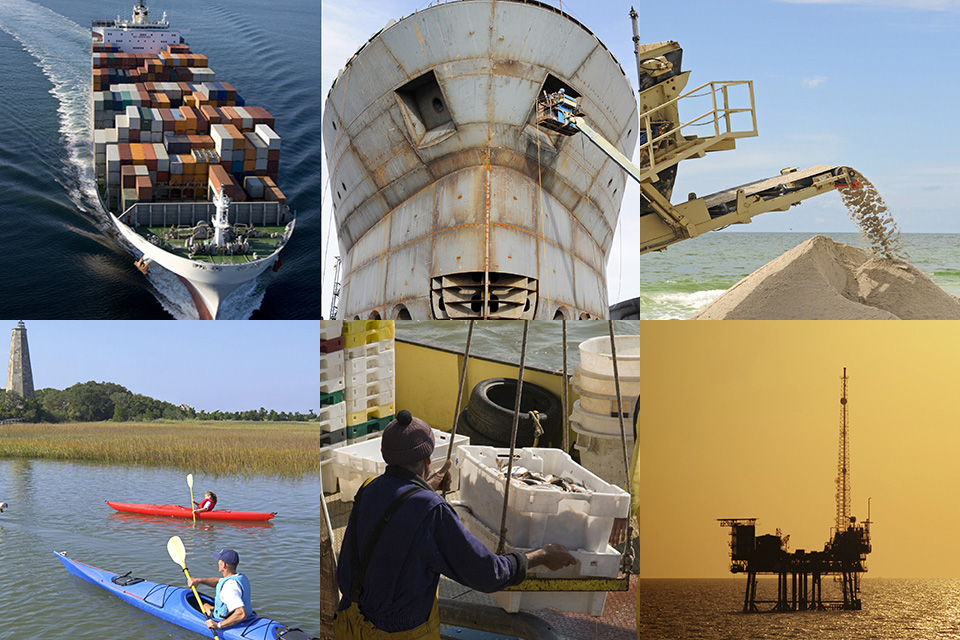
| [NEW] Photo Contest: Coastal Management in Action From balancing development with natural areas to protecting economic powerhouses, coastal management keeps our coasts thriving. For the tenth annual coastal management photo contest, we want to see your photos of coastal management in action. Show us your natural infrastructure projects, beautiful beaches you work to protect, working waterfronts, and more! Find inspiration from the list of nine categories. Submit photos to the tenth Coastal Management photo contest. Winners will be chosen by a panel of judges and will be featured on our social media during the month of May. Submit your photos by May 1, 2026. [NEW] Requesting Applications for 2026 New Hampshire Coastal Resilience Grant Projects The New Hampshire Department of Environmental Services (NHDES) Coastal Program is requesting 2026 Coastal Resilience Grant (CRG) applications for projects. Projects must take place in one or more of New Hampshire’s Coastal Zone communities. The CRG funding opportunity supports projects that build capacity, advance planning, and develop designs to increase coastal resilience, with specific focus on community and/or habitat resilience. Approximately $100,000 in CRG funding is available. Applicants must request a minimum of $15,000 and no more than $40,000 per project. Funds are made available to the NHDES Coastal Program through the National Oceanic and Atmospheric Administration Office for Coastal Management, under the Coastal Zone Management Act. For instructions, evaluation criteria, and to access the Application Form, visit the CRG website. [NEW] NOAA’s Flower Garden Banks National Marine Sanctuary Management Plan Review NOAA’s Office of National Marine Sanctuaries is initiating a public process for reviewing the management plan of Flower Garden Banks National Marine Sanctuary. This management plan review will ensure that the sanctuary’s resource protection, research, and education and outreach activities continue to effectively address current and emerging issues in the sanctuary. NOAA is asking for comments, through May 21, on the scope of the management plan review. This comment period is the first of multiple opportunities that interested parties will have to provide input into this review. For more information on NOAA’s topic areas of focus, please review the notice. Learn more here. CSO Executive Director on ASPBA Podcast: Shaping Shores CSO’s Executive Director Derek Brockbank was a guest on the American Shore and Beach Preservation Association podcast, “Shaping Shores.” This podcast series celebrates ASBPA’s 100th Anniversary. The episode also features Nicole Elko and discusses where ASBPA can help lead coastal communities over its next 100 years. Listen to the episode here. Funding Opportunity: Fiscal Year 2024 & 2025 Building Resilient Infrastructure and Communities The Building Resilient Infrastructure and Communities (BRIC) grant program makes federal funds available to states, U.S. territories, federally recognized tribal governments, and local governments for hazard mitigation activities. It does so by recognizing the need to upgrade and modernize the nation’s infrastructure against the growing risks to communities and the need for natural hazard risk mitigation activities that promote resilience with respect to natural hazards. For this funding opportunity, the program prioritizes investment in infrastructure and construction projects that deliver immediate, measurable risk reduction to communities vulnerable to natural hazards. BRIC emphasizes the adoption and enforcement of modern building codes and limits capability- and capacity-building activities to those directly tied to infrastructure resilience, such as building code adoption and enforcement. Apply here. Calling All Hosts: New NOAA Training on Oral Histories Across many fields, including coastal management, oral histories are a tool for learning detailed information about people, places, and events. Host this course to bring the knowledge to co-create oral history interviews to your community. Participants will learn best practices for conducting oral histories that produce qualitative data, communication tips for sharing the value of these histories, and much more. Email NOAA’s Office for Coastal Management to learn how to share this training with your colleagues. Call for Abstracts ASBPA National Coastal Conference The American Shore and Beach Preservation Association (ASBPA) is pleased to announce a Call for Abstracts for the National Coastal Conference, celebrating 100 years of shore and beach preservation, to be held in New Jersey where in 1926 the first beach preservationists seeded a revolutionary idea for future coastal protection. The ASBPA National Coastal Conference, October 5-8, 2026 in Atlantic City, New Jersey, welcomes all coastal managers and stakeholders to learn the latest science, engineering, and policy needed to maintain and improve the health of our beachfront and estuarine shorelines and ecosystems, while developing collaborative networks to promote best management practices. Abstracts are due June 1st for PowerPoint presentations and August 15th for Poster Presentations. View the call for abstracts here. Report: Priorities for Sustainable and Responsible Development of Offshore Renewable Energy on the West Coast A new congressionally mandated report from the National Academies of Sciences, Engineering, and Medicine lays out strategies for the U.S. Coast Guard and other federal agencies to follow when planning offshore renewable energy projects along the U.S. West Coast. The report makes recommendations on data collection, interagency coordination, community engagement, and environmental protection that can inform the region’s clean energy agendas as well as consider the complex commercial, recreational, and security operations also taking place in those waters. The recommendations are intended to capture best practices and improve research, engagement, safety, and governance. The report outlines key benefits of the West Coast’s offshore wind development, including clean energy, job creation, local economic gains, and expanded scientific research and ecosystem monitoring, alongside potential drawbacks such as restricted fishing access, port disruption, maritime safety concerns, and marine ecosystem impacts. Read the press release here. Coastal Southeast Technical Assistance Application The Coastal Stormwater Center of the Southeast (CSC) is one of four EPA-funded Stormwater Centers of Excellence across the U.S. The Center for Watershed Protection is honored to lead the CSC alongside an incredible team of partners: University of Florida, East Carolina University, North Carolina Coastal Federation, Clemson University, Virginia Tech, University of Georgia, and Auburn University. Through the CSC, we’ll be offering technical assistance at no cost, to state, Tribal, and local governments and environmental non-profits tackling stormwater challenges across coastal VA, NC, SC, GA, FL, and AL. This is just one of the many initiatives we’ll be rolling out to support resilience and innovation across the region. Learn more here. |