The Coastal States Organization represents the nation’s Coastal States, Territories, and Commonwealths on ocean, coastal, and Great Lakes resource issues. Having trouble opening links? View this on our website: https://coastalstates.org/resources/ |
|
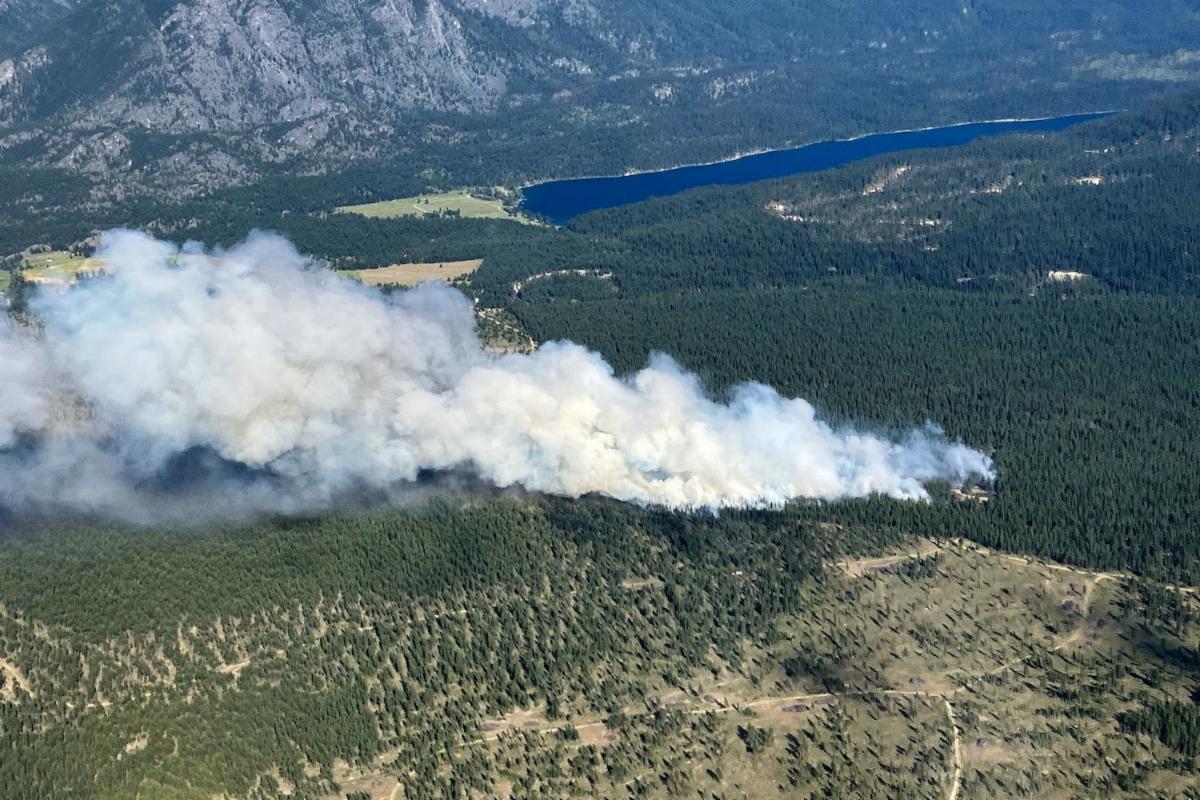
How Wildfires Harm Coasts |
|
Source: BC Wildfire Service via Reuters |
|
| Wildfire season is fully underway. These disasters have scorched the western United States and Canada, spreading smoke to the East Coast and Great Lakes. With over 90 fires burning nationwide, 2026 has been an especially active year for these disasters. Along with destroying forests, houses, and communities, wildfires can have significant impact on coastal environments. A study in Nature found that fires can negatively affect water quality in effected areas for up to 8 years. Wildfires can also result in loss of kelp forests, altered water flow in wetlands, and habitat and food chain disruption for marine species. Following the Palisades and Eaton fires in early 2025, nonprofit Heal the Bay is working with state and local government to develop response plans for beach safety and habitat restoration. Over a year and a half later, there are still issues with water quality and hazardous debris. More data on wildfires can be found here. |
|
| In the States and Territories |
|
| Why New Jersey Sank an Entire Bridge into the Ocean For the Sea Bright Bridge, decades of nor’easters, blizzards, heavy traffic, salt, frigid cold, and blazing heat, led to cracks, rust, crumbling concrete, and other age-related problems. Built in 1950, the span finally reached retirement age and had to be replaced. Fortunately, the old bridge found a new home under the water instead of over it as part of New Jersey’s Artificial Reef Program. The project required collaboration from the Department of Environmental Protection, Monmouth County Board of Commissioners, New Jersey Division of Fish and Wildlife, R.E. Pierson Construction, and the towns of Sea Bright and Rumson. New Jersey’s artificial reef program does not rely solely on repurposed concrete for material. In the past, decommissioned barges, tug boats, and old subway cars have been sunk on the sites. The state has also deployed reef balls, pre-cast hollow concrete structures with multiple openings that invite marine life to set up house. Read more here. Endangered Kemp’s Ridley Sea Turtle Returns to Atlantic after Successful Rescue and Rehab An Endangered Kemp’s ridley sea turtle named Pancake successfully returned to the Atlantic Ocean today outside the Wildlife Conservation Society’s New York Aquarium, marking the culmination of months of rehabilitation and celebrating the New York State Environmental Protection Fund (EPF) and the partnerships that make marine wildlife conservation possible. Pancake, an Endangered juvenile Kemp’s ridley sea turtle estimated to be between two and five years old, was found suffering from cold stunning on Nov. 22, 2025, at Duck Harbor Beach in Wellfleet, Massachusetts. After being rescued by the Massachusetts Audubon Society, Pancake was transported to the New England Aquarium for emergency triage and medical treatment before being transferred on Dec. 3 to the Atlantic Marine Conservation Society’s Sea Turtle Care Facility in Westhampton Beach, where the turtle underwent months of specialized rehabilitation. Now weighing approximately 11 pounds, Pancake made a full recovery, demonstrating strong swimming behavior while actively pursuing food and maintaining a healthy diet of shrimp and clams before being cleared for release. Pancake is one of 25 sea turtles transferred to AMSEAS for rehabilitation during this cold-stunning season and one of 125 sea turtles treated at the organization’s Sea Turtle Care Facility since 2020. Read more here. |
| Louisiana Partners with US Army Corps to Fast-Track Coastal Tech and Resilience The Louisiana Coastal Protection and Restoration Authority (CPRA), the Louisiana Department of Transportation and Development (DOTD) and the Army Corps of Engineers agreed to the partnership at a meeting in Baton Rouge in June. “The Summit at Sea Level was such a momentous occasion for the US Army’s Civil Works mission and the State of Louisiana,” Assistant Secretary of the Army for Civil Works Adam Telle said in an Army Corps of Engineers press release on the New Orleans district website. The Louisiana Coastal Protection and Restoration Authority listed 19 “consensus and strategic takeaways” from its summit, including designating a national area for wetland mitigation in Louisiana and considering best real estate practices for coast preservation. Read more here. Gulf Fishery Management: Progress Through Partnership From spiny lobster in the Florida Keys to red snapper off the coast of Texas, the Gulf of America’s rich waters support robust recreational and commercial fisheries. In fact, this area leads the nation in recreational landings, generates the second largest commercial landings revenue, and fuels a $20 billion annual fishing economy. Effectively managing Gulf fisheries requires balancing a billion-dollar commercial industry with a massive recreational sector. The federal government, the Gulf Council, and Gulf states each play a distinct role in this process. The Gulf Council and NOAA Fisheries manage resources in federal waters across six management plans, covering: 31 reef fish, such as snappers and groupers; coastal migratory pelagics, including king mackerel and cobia; spiny lobster, shrimp, and stone crab; more than 200 coral species; and essential habitats. Read more here. |
| Once Extirpated in PA, the Piping Plover’s Resurgence Hits Decade Milestone Absent from Pennsylvania for over 60 years, the federal and state endangered piping plover, a small shorebird, has made a comeback at Presque Isle State Park in Erie. Federal, state and local officials came together at the Tom Ridge Environmental Center in Erie this past weekend for “Pennsylvania Piping Plover Fest,” a celebration of the shorebird’s ten consecutive years of nesting in the Commonwealth. The Presque Isle shoreline is the only breeding habitat for the piping plover in Pennsylvania. However, increased recreational activity throughout the years endangered camouflaged eggs in shallow depressions in the sand. Piping Plovers eventually abandoned Presque Isle by the mid-1950s, like many other nesting sites throughout the Great Lakes. From a habitat standpoint, DCNR and staff at Presque Isle State Park have worked to protect and restore the dynamic shoreline and fragile habitat at Gull Point. Soon after Presque Isle became a state park, the Commonwealth recognized the ecological importance of the area by designating Gull Point as a bird sanctuary in 1927 and reaffirming that protection in 1957. These efforts support species like the Piping Plover and the Common Tern and are strengthened by the presence of native plant communities that form the backbone of healthy coastal ecosystems. Read more here. Michigan Fisheries Get One-Time Funding for Whitefish Restoration Michigan’s Department of Natural Resources Fisheries Division received one-time funding of $350,000 for whitefish recovery from the state budget. The ailing species has undergone a rapid population decline in recent years, and for the first time, recovery efforts have a specific line in the state budget. “Populations were very strong until the 50’s and 60’s but when the sea lamprey invasion really hit hard, most populations declined,” said Randy Claramunt, the state fisheries chief. “They rebounded up until the time when the next big invasive introduction happened in the Great Lakes.” Now, invasive zebra and quagga mussels have caused another decline in the population, but this time it’s a crisis, Claramunt said. Read more here. |
| Guam, Marianas Islands Residents Rebuilding Their Lives Again after Two Super Typhoons Hit the Region Just Weeks Apart The people on Guam and the Marianas Islands are starting to rebuild their lives after living through two catastrophic typhoons that struck the region only 83 days apart. They are living with physical, financial, and psychological burdens, many being displaced twice since April. Super Typhoon Sinlaku hit the region on April 14, causing widespread damage. Then it happened again ─ Super Typhoon Bavi made landfall on July 6 as thousands of people were living in tents or with tarps for roofs. Bavi forced many of these families to evacuate again and delayed any recovery they had planned. “Following two catastrophic typhoons within 83 days, our purpose is not to merely deliver standard disaster services, but to reduce the burdens borne by survivors,” reported Brad Kieserman, vice president, Disaster Operations and Logistics for the Red Cross. “In the spirit of Inafa’maolek ─ to restore harmony and order ─ we will tailor services to the distinct needs, cultures, and conditions of each island and community, working in unified partnership with survivors and community partners.” Read more here. California State Parks and Peninsula Open Space Trust Announce Permanent Conservation of San Gregorio Rnach and Planned Expansion of State Beach by 50% Beachgoers along the San Mateo County coast will soon enjoy expanded access at San Gregorio State Beach following the recent acquisition by Peninsula Open Space Trust (POST) of 238-acre San Gregorio Ranch, which sits at Highway 1 and Highway 84. While POST plans to donate this $10-million property to California State Parks (State Parks) later this year, visitors will be able to access the property as an extension of the state beach beginning July 29. The ranch site, which includes more than half a mile of beachfront, has been temporarily closed for maintenance and safety upgrades in preparation for the public opening later this month. Through a new agreement between POST and State Parks, nonprofit operating partner Friends of Santa Cruz State Parks (Friends) will support day-to-day park operations, including visitor services staffing and entrance fee collection. California State Coastal Conservancy Executive Officer Amy Hutzel affirmed the partners’ vision for expanded public access. “Completing the acquisition of San Gregorio Ranch has been a priority for the State of California to preserve and expand access to this remarkable stretch of coast,” she said. “We are proud to have supported the acquisition by POST, which will help more Californians experience the rugged beauty of the San Mateo County coast.” Read more here. |
| [NEW] 2026 National Estuaries Week Photo Contest NOAA’s Office for Coastal Management is hosting a photo contest to celebrate National Estuaries Week from September 19 to 27, 2026. Send them your best photos from the National Estuarine Research Reserves that display the beauty of the reserves, critters that live there, and the people who work and play there. Winners will be chosen by a panel of judges and will be featured in their social media campaign during National Estuaries Week. Details for how to enter are located on the contest webpage. California Ocean & Coastal Amateur Photography Contest California is in many ways defined by its coast and ocean. This contest pays tribute to these special places, honors the diversity of wildlife they support, and celebrates access for all. Pictures can feature any of the following subjects: the scenic coast and Pacific Ocean off California, the people of the California Coast, and California ocean and coastal wildlife. Contest entry is free and open to all amateur photographers. Submissions are due by 5pm, September 30, 2026. For more information or questions about entries, contact Lauren.Dung@coastal.ca.gov. Learn more here. TNC Launches New Tool for Coastal Resilience TNC and partners released a first‑of‑its‑kind Coastal Resilience methodology that quantifies, in U.S. dollars, the flood-protection value mangroves and tidal marshes deliver to coastal property and communities. Natural protections like mangroves and tidal marshes absorb incoming wave energy at higher rates, protect against storms at lower costs, and provide co-benefits like carbon absorption that mitigates future climate impacts. If a portion of our current protection spending was shifted toward nature‑based solutions, infrastructure needs would reduce, maintenance costs would lower and future flood damages could be avoided. Learn about the tool here. NOAA Announces New High-Resolution Land Cover Data NOAA has announced the availability of new high-resolution land cover data—used to document key geographic and landscape features covering Earth’s surface—for coastal communities in Puget Sound, Rhode Island, Northeast Ohio, Mississippi, and Alabama. This new data can be used to protect communities from flooding, inform wetland restoration projects, improve water quality, and more. The data are available from the Digital Coast website. Please reach out to Nate Herold (nate.herold@noaa.gov) if you have any questions. Call for Abstracts ASBPA 100th Anniversary Conference The American Shore and Beach Preservation Association (ASBPA) is pleased to announce a Call for Abstracts for the National Coastal Conference, celebrating 100 years of shore and beach preservation, to be held in New Jersey where in 1926 the first beach preservationists seeded a revolutionary idea for future coastal protection. The ASBPA National Coastal Conference, October 5-8, 2026 in Atlantic City, New Jersey, welcomes all coastal managers and stakeholders to learn the latest science, engineering, and policy needed to maintain and improve the health of our beachfront and estuarine shorelines and ecosystems, while developing collaborative networks to promote best management practices. Abstracts are due August 15th for Poster Presentations. View the call for abstracts here. Funding Opportunity: Fiscal Year 2024 & 2025 Building Resilient Infrastructure and Communities The Building Resilient Infrastructure and Communities (BRIC) grant program makes federal funds available to states, U.S. territories, federally recognized tribal governments, and local governments for hazard mitigation activities. It does so by recognizing the need to upgrade and modernize the nation’s infrastructure against the growing risks to communities and the need for natural hazard risk mitigation activities that promote resilience with respect to natural hazards. For this funding opportunity, the program prioritizes investment in infrastructure and construction projects that deliver immediate, measurable risk reduction to communities vulnerable to natural hazards. BRIC emphasizes the adoption and enforcement of modern building codes and limits capability- and capacity-building activities to those directly tied to infrastructure resilience, such as building code adoption and enforcement. Apply here. |
|
| The views expressed in articles referenced here are those of the authors and do not represent or reflect the views of CSO. If you have a news item or job posting to include in future CSO Newsletters, please send an email to: ecrocco@coastalstates.org with a subject line: “Newsletter Content”. Please include the information to be considered in the body of the email. Please note: CSO reserves final decision regarding published newsletter content and may not use all information submitted. |
|
| Coastal States Organization | 50 F Street. NW, Suite 570, Washington, DC 20001 | 202-800-0580 | cso@coastalstates.org | www.coastalstates.org |
|
|
|
|