The Coastal States Organization represents the nation’s Coastal States, Territories, and Commonwealths on ocean, coastal, and Great Lakes resource issues. Having trouble opening links? View this on our website: https://coastalstates.org/resources/ |
|
12 Days of Coastal Zone Management |
|
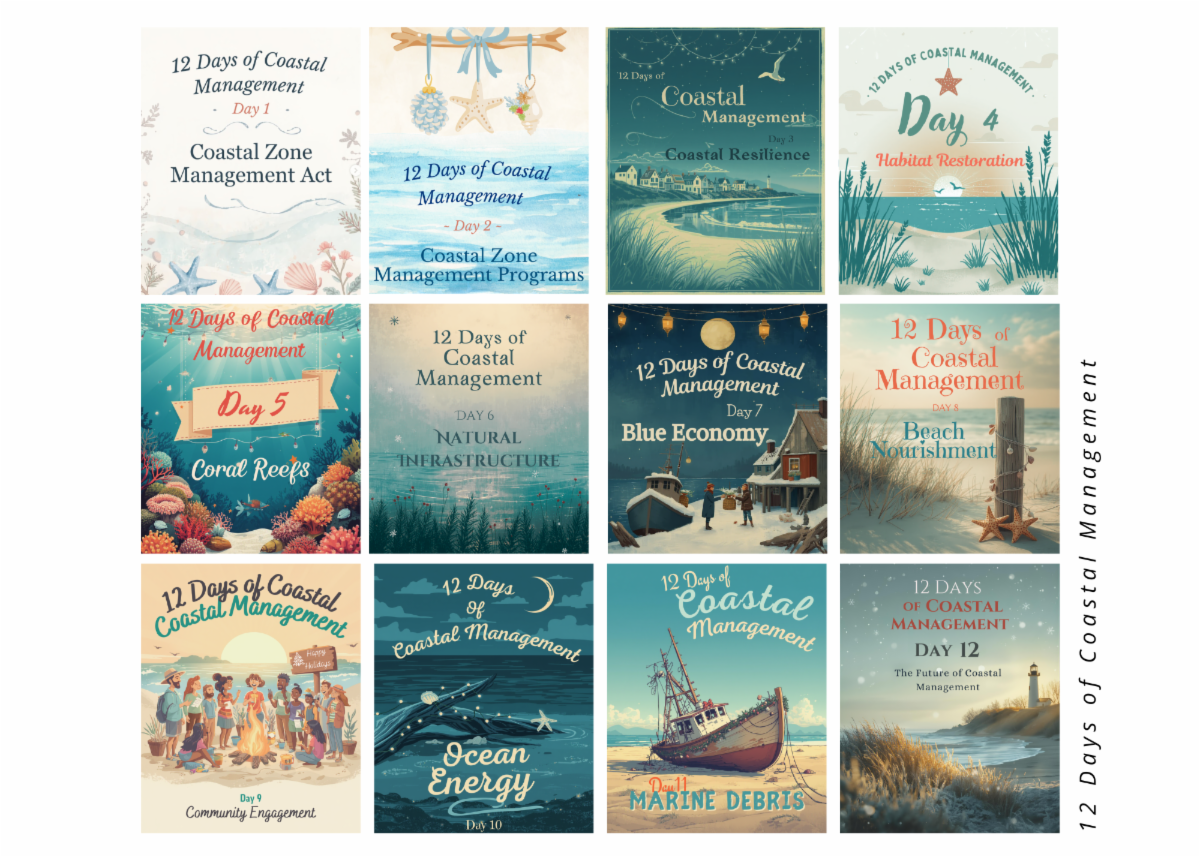
| Join CSO this holiday season as we celebrate the ‘12 Days of Coastal Management’. Each day, between Dec. 14th – Dec. 25th, on our social media feeds, we’ll be highlighting a different aspect of coastal zone management. During the first 5 days, we have focused on the Coastal Zone Management Act, coastal management programs, resilience, habitat restoration and corals. This campaign has given us the opportunity to showcase coastal management projects around the country, including a resilience project on North Cove Beach, Washington, habitat restoration efforts on the Oyster River in New Hampshire and the Little Calumet River in Indiana, and the Coral Reef initiative in the U.S. Virgin Islands. In the coming days, we’ll also be looking at: Blue Economy, Community Outreach, Natural Infrastructure, Beach Nourishment, Ocean Energy, Marine Debris, and the Future of Coastal Management. To learn more about the projects featured, check out each day’s caption on CSO’s Facebook or Instagram and help share spread the word by liking and sharing these posts! |
|
| In the States and Territories |
|
| Massachusetts – Duxbury Receives Grant Funding for Wetlands Study The Massachusetts Office of Coastal Zone Management has awarded the Town of Duxbury a grant of more than $94,000 to support the development of a comprehensive habitat restoration plan for the upper Bluefish River wetland. The project will focus on evaluating habitat conditions and water quality to identify key stressors—such as tidal restrictions, stormwater runoff, invasive phragmites australis, and barriers to fish passage. While no physical restoration work will be conducted under this grant, the findings will guide future solutions to address flooding issues on Harrison Street. Read more here. $7.5 Million Grant Renewed to Protect Georgia Coastlines The National Science Foundation (NSF) has renewed a $7.5 million grant for the largest scientific project on the Georgia coast and one of NSF’s premier long-term ecosystem studies. Run by the University of Georgia (UGA) Marine Institute on Sapelo Island, the Georgia Coastal Ecosystems (GCE) research program aims to understand how coastal ecosystems function, how they change over time and how they may be affected by future human and climate-related pressures. The new phase will expand research into how extreme ecological disturbances effect the resilience of coastal salt marshes and estuaries across the GCE study area, which stretches from northern Sapelo Island down to Little St. Simons Island. “We want to know whether changes in variability can actually tell us something about a system’s underlying health,” Merryl Alber, director of the Marine Institute, said in a press release. “Extremes matter, and we’re learning how those extremes shape the resilience of our marshes.” Researchers will measure factors such as flooding, temperature and salinity to better understand how these ecosystems respond to shifting conditions, information that can guide policy decisions and coastal management. Read more here. |
| U.S. Army Corps of Engineers, Texas General Land Office, and Gulf Coast Protection District Unite to Advance the Coastal Texas Project The Texas General Land Office (GLO), in partnership with the Gulf Coast Protection District (GCPD), is proud to announce the approval of two engineering design contracts that will advance the largest coastal protection effort in U.S. history— the Coastal Texas Project. These contracts mark a significant milestone in moving this historic federal initiative toward construction. “Everything is bigger in Texas – including the Coastal Texas Project, which is the largest coastal resiliency undertaking in U.S. Army Corps of Engineers history that will feature the largest barrier gate system in the world. We can no longer wait to implement this long-term resiliency strategy, aimed at safeguarding the largest port and petrochemical complex in the nation,” said GLO Commissioner, Dawn Buckingham, M.D. The Galveston Bay Barrier System, also known locally as the “Ike Dike,” is the largest element of the broader Coastal Texas Project, accounting for 85 percent of the $35 billion authorized cost. “The Gate,” a historic federal initiative that will serve as the largest flood gate system in the world, and the Beaches and Dunes features are the first two components of the Galveston Bay Barrier System to move into design. Read more here. Louisiana – CPRA Celebrates Completion of the Lake Borgne Marsh Creation Project The massive Lake Borgne Marsh Creation Project in St. Bernard Parish is finished. The Louisiana Coastal Protection and Restoration Authority celebrated the milestone with a ribbon-cutting ceremony this week on Shell Beach. The five-year construction project restored 3,180 acres of marsh along the lake’s south shore. “It provides resiliency to the community, helps stabilize the lake rim, and provides additional security and resiliency to the overall hurricane protection system that was built to protect the greater New Orleans area,” says Michael Hare, CPRA executive director. Not only did the project have a direct economic impact of more than $32 million on the region, but the final price tag will come in about $5 million less than the original projections. Read more here. |
| Pennsylvania – DEP Awards Funding to Protect Lake Erie Coastal Zone The Pennsylvania Department of Environmental Protection (DEP) awarded Coastal Zone Grants totaling more than $168,000 to four projects in the state’s Northwest region. The grants will fund projects that will help protect and restore the Lake Erie Coastal Zone. “The Lake Erie Coastal Zone is the treasure of the Erie community and provides extraordinary environmental, economic, and community resource that is under pressure from threats such as development, pollution, and climate change,” said DEP Secretary Jessica Shirley. Coastal Zone Grants are awarded to projects related to fisheries, wetlands, recreation, public education, coastal hazards such as bluff recession, and other areas. Grants may also be awarded to other projects in the watershed that have an impact on coastal waters. The 77-mile Lake Erie Coastal Zone is in Erie County and includes the Lake Erie shoreline and several major tributaries. The coastal zone also extends to the middle of the lake, to the international boundary with Canada, and inland an average of 1.4 miles. Read more here. Michigan – Tribes Move Whitefish Upriver in Bid to Revive Great Lakes Runs As once-abundant Great Lakes whitefish slide toward population collapse, biologists are trying something that would have sounded far-fetched a decade ago: hauling live fish upriver and simply letting them go. This month, the Sault Ste. Marie Tribe of Chippewa Indians and partner scientists released nearly 200 adult whitefish into the upper Carp River. The “translocation” effort aims to get the fish to do what their ancestors did before the logging era destroyed Michigan river habitat — spawn and produce babies that eventually return on their own. Whitefish, a backbone of tribal and commercial fisheries, have suffered a steep collapse in the lower Great Lakes as invasive zebra and quagga mussels strip out phytoplankton at the base of the food chain, leaving less food for native zooplankton and baby fish. According to the Great Lakes Fishery Commission, whitefish recruitment has crashed by 70–80 percent since the late 1990s in Lake Michigan and Lake Huron due to the combined effects of mussel-driven food scarcity and declining winter ice cover. Newly introduced bipartisan Congressional legislation introduced this month would devote $500 million over the next decade to battling invasive mussels and scaling up large-scale suppression technologies on part with lamprey control efforts launched in the 1950s. Read more here. |
| CNMI – NOAA Awards over $26.4 Million for Marine Debris Removal Thirteen new projects have been funded for over $26.4 million under the NOAA Marine Debris Program, with a focus on abandoned and derelict vessels and fishing gear, and the use of proven debris interception technologies. Recipients of the funding announced on Dec. 4 by the NOAA Marine Debris Program for fiscal year 2025 included nine for large-scale marine debris cleanup and four using debris technologies. Pacific Coastal Research & Planning, a small non-profit in the Northern Mariana Islands, was allocated $4.9 million to remove 23 abandoned boats and an estimated 40,000 pounds of derelict fishing gear from the coastal environments of the U.S. Territory of the Commonwealth of the Northern Marianas Islands, and the Freely Associated States of the Republic of Palau and Federated States of Micronesia. NOAA also awarded funding to the Rhode Island Coastal Resources Management Council. Read more here. Hawaiʻi County Awarded $1.9 million Grant for Puapuaʻa Iki Habitat Restoration The County of Hawaiʻi Office of Sustainability, Climate, Equity, and Resilience (OSCER) has been awarded $1.9 million in federal grant funds to support the Puapuaʻa Iki Habitat Restoration Project. This initiative aims to restore native ecosystems, preserve historic and cultural sites, and strengthen community resilience against climate impacts such as erosion, flooding, and sea level rise at Puapuaʻa Iki, a parcel of land in Kona managed by the County’s Public Access, Open Space, and Natural Resources Preservation Commission (PONC) program. Puapuaʻa Iki has deep cultural and ecological significance and has long faced challenges from invasive species, erosion, and trespassing. Key project activities include the establishment of the community advisory group, landscape planning and environmental assessment to ensure environmental compliance, cultural site restoration, and ecological site restoration efforts focused on replanting native vegetation and stabilizing the shoreline. The restoration will cover approximately 11.5 acres of lowland coastal dry/mesic forest and will include careful work around the heiau and burial sites to protect these culturally important areas. Read more here. |
| Great Lakes Climate Adaptation Resource Guide For hundreds of small and medium-sized communities across the Great Lakes region, preparing for the water-related impacts of changing weather patterns can be challenging. The International Joint Commission’s (IJC) Great Lakes Water Quality Board has developed a new Great Lakes Climate Adaptation Resource Guide. The guide highlights tools and approaches (including the CALM community of practice!) to help communities integrate Great Lakes water topics into their climate adaptation and resilience strategies. For additional information, read the one-pager or view the informational webinar. Read the full guide here. Coastal Southeast Technical Assistance Application For those that haven’t heard, the Coastal Stormwater Center of the Southeast (CSC) is one of four EPA-funded Stormwater Centers of Excellence across the U.S. The Center for Watershed Protection is honored to lead the CSC alongside an incredible team of partners: University of Florida, East Carolina University, North Carolina Coastal Federation, Clemson University, Virginia Tech, University of Georgia, and Auburn University. Through the CSC, we’ll be offering technical assistance at no cost, to state, Tribal, and local governments and environmental non-profits tackling stormwater challenges across coastal VA, NC, SC, GA, FL, and AL. This is just one of the many initiatives we’ll be rolling out to support resilience and innovation across the region. Learn more here. Funding Opportunity: Great Lakes Restoration Community Grant Program The Great Lakes Restoration Community Grant Program (GLRCGP) application is now open! The program’s primary goal is to fund restoration projects in Great Lakes communities with environmental concerns in support of GLRI objectives and offer technical assistance and minimize administrative challenges associated with applying for and managing federal grant funds. Cities, states, Tribes and nonprofit organizations representing Great Lakes communities can apply directly to the Great Lakes Restoration Community Grant Program. The submission deadline for Letters of Intent is January 16, 2026. Learn more here. Partnership Efforts and New Resources to Support BUDM Through its Coastal Zone Initiative to increase coastal habitat restoration and Beneficial Use of Dredged Material (BUDM) for habitat restoration and resource protection in the US, Manomet Conservation Sciences has worked with the Coastal States Organization and numerous partners to advance BUDM project planning in partnership with the U.S. Army Corps of Engineers in Southeast states, develop case studies on coastal restoration projects, and deliver a series of technical webinars. Deliverables, recordings, and more information are available on the Coastal Zone Initiative webpage. Serious Games for Coastal and Marine Conservation, Management, and Adaptation So-called “serious games” are designed for purposes beyond just entertainment, and they can be a powerful tool for teaching, engaging stakeholders, conducting research, and evaluating public policy. OCTO’s The Skimmer newsletter has compiled information about role-playing/simulation games that allow players to experiment with coastal and marine conservation, management, and adaptation actions (or inaction) to improve understanding of how coastal and marine ecosystems – particularly resource users and human communities – work. This compilation of games is continually updated. If you have additional games for us to consider, please send relevant information to sarah@octogroup.org. We are specifically looking for games with a management or conservation component (i.e., not solely focused on species identification or ecology.) Thank you for your assistance! Funding Opportunity: $1.45 Billion in Supplemental Economic Funding Available for Disaster Recovery The United States Economic Development Administration has announced the Notice of Funding Opportunity (NOFO) for its Fiscal Year (FY) 2025 Disaster Supplemental Grant Program. This program makes approximately $1.45 billion available to areas that received major disaster declarations in the calendar years 2023 and 2024 for economic recovery activities. Funds can support both construction and non-construction projects. State and local governments, Native tribes, higher education institutions, public or private non-profit organizations that work with local government, economic development organizations, and public-private partnerships for public infrastructure are eligible. The EDA will fund up to 80% of the project with higher percentages available for severely distressed applications and Tribal organizations. Applications are accepted on a rolling basis until funds are spent for Readiness and Implementation path projects, while Industry Transformation grants will be due March 3, 2026. For more information, contact Rania Campbell-Bussiere. |
|
| The views expressed in articles referenced here are those of the authors and do not represent or reflect the views of CSO. If you have a news item or job posting to include in future CSO Newsletters, please send an email to: ecrocco@coastalstates.org with a subject line: “Newsletter Content”. Please include the information to be considered in the body of the email. Please note: CSO reserves final decision regarding published newsletter content and may not use all information submitted. |
|
| Coastal States Organization | 50 F Street. NW, Suite 570, Washington, DC 20001 | 202-800-0580 | cso@coastalstates.org | www.coastalstates.org |
|
|
|
|